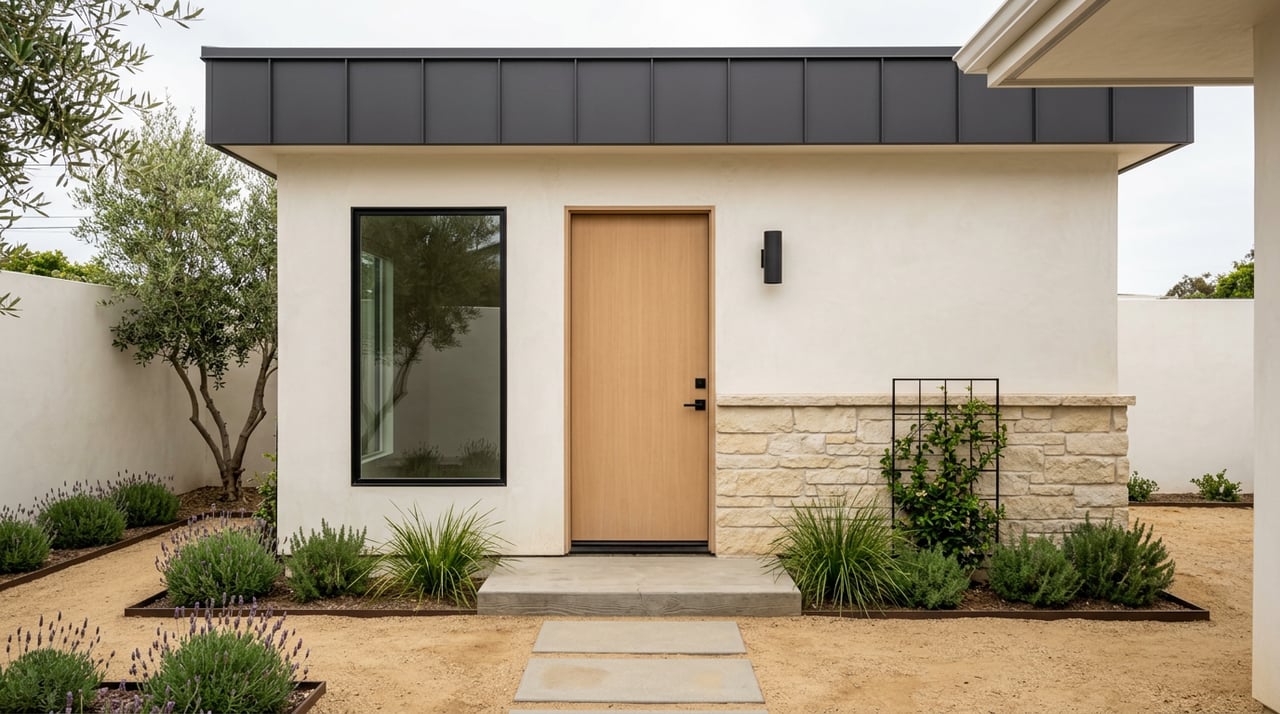
Two Sacramento homeowners pull permits for nearly identical 720-square-foot backyard cottages this summer. Same floor plan, same finishes, same contractor. One project closes at roughly the modeled cost. The other lands $38,000 over budget because a camera inspection failed the original home's sewer lateral halfway through framing, and the panel needed a service upgrade to carry the second kitchen. When those two homes list next spring, the market will price them very differently, and the difference will have almost nothing to do with the ADU itself.
That is the quiet story of the 2026 Sacramento ADU market. The state and the city have cleared away almost every front-end obstacle. What is left, as the deciding variable in resale outcomes, is the condition of the original house.
The 2026 rules did most of the heavy lifting
Sacramento's permit environment this year barely resembles the one from three years ago. A short list of what changed:
- SB 543 locked in a 15-day permit intake deadline statewide and clarified that ADU size limits refer to interior livable square feet, not the exterior footprint. Designers can now build to the full 750-square-foot fee threshold without leaving margin for wall thickness.
- AB 1154 allows lenders to count projected ADU rent toward mortgage qualification for the loan that builds the unit. This is the change that reopens the project to owner-occupants who could not qualify on W-2 income alone.
- SB 937 defers most impact fees to final inspection or certificate of occupancy, easing the cash burden during construction.
- AB 976 permanently removed owner-occupancy requirements, so both units on the parcel can be rented.
- AB 2533 provides a safety-only path to legalize older unpermitted ADUs, which matters in Curtis Park, Tahoe Park, and East Sacramento where informal in-law units have existed for decades.
Layer on the city's own tooling. The Sacramento Community Development Department at 300 Richards Boulevard publishes an ADU Fee Estimate schedule that was last revised on June 5, 2026, and the department maintains pre-approved plan sets through its ADU Ally and EZPermit programs. A 749-square-foot detached unit shows a building permit fee near $1,268 and a plan review fee of $532 on the current schedule, with fire, planning, and public works deposits stacking on top. Units under 750 square feet remain exempt from most development impact and school fees.
Permit applications in Sacramento are up more than 300 percent since 2020. The city has spent five years trying to say yes.
The resale premium is real, but the range is wide
Third-party California ADU models place the median resale uplift for a detached, permitted ADU at roughly 28 percent of the underlying home's value. In dollars, that reads as an added $150,000 to $250,000 on a standard detached unit at current Sacramento pricing, with the wider range reflecting neighborhood, build quality, and layout.
Rental income is easier to pin down because appraisers use the same data:
| Submarket | Typical 1BR ADU rent | Typical 2BR ADU rent |
|---|---|---|
| Midtown / Downtown | $1,600–$2,200 | $1,900–$2,400 |
| East Sacramento / Land Park | $1,500–$1,900 | $1,800–$2,200 |
| Curtis Park / Tahoe Park | $1,400–$1,800 | $1,700–$2,100 |
| Broader Sacramento (2026) | $1,300–$1,800 | $1,600–$2,200 |
At a $1,495 monthly modeled rent on a mid-range detached build, published Sacramento ADU pro formas show a cap rate near 6.8 percent with 95 percent occupancy. That is competitive with what an out-of-area rental would generate, and it explains why the top ADU-investment neighborhoods cluster around UC Davis Medical Center and Sacramento State demand: Curtis Park, Midtown, Tahoe Park, East Sacramento, and Land Park.
Here is where the interpreted picture matters. That 28 percent uplift is a median across a wide distribution. The units at the top of the range share three traits: they are permitted, they are metered or sub-metered so a buyer can immediately underwrite the rent, and the primary home's core systems were brought up to spec during construction. The units at the bottom of the range are the ones where the ADU works but the main house shows the strain of accommodating it.
The friction that decides which camp you land in
Sacramento's older submarkets, the same ones that command the strongest ADU rents, sit on the oldest infrastructure. Cast iron, clay, and in some cases Orangeburg or transit sewer laterals are common in homes built before the 1970s in East Sacramento, Land Park, Curtis Park, and Tahoe Park. Sewer lateral replacement in Sacramento runs roughly $50 to $100 per foot, and a typical run to the city main is 60 to 80 feet.
A backyard ADU adds a second kitchen, a second bathroom, and often a laundry hookup. That load is what turns a lateral that "worked fine" into one that fails a pre-construction camera inspection or, worse, backs up under load after the certificate of occupancy is issued. A permitted ADU built over a distressed lateral is not a resale asset. It is a disclosure item.
Two other line items tend to catch owners:
- Electrical service. A 100-amp panel can rarely absorb a second full unit without an upgrade to 200 amps, and SMUD's meter and service coordination adds weeks.
- Water and sewer connections. ADUs generally tie into the existing lateral and water main, but the city's fee schedule leaves room for additional sewer and water tap charges if the tie-in cannot be made cleanly. Public Works review carries a $205 deposit plus hourly billing on top of the base permit.
Total permit costs for a Sacramento ADU commonly run $4,500 to $12,000, and the spread inside that range is almost entirely a function of whether sewer, panel, or meter work is triggered.
None of this shows up in the online ADU calculators. It shows up on the invoice at month four of a nine-month build.
Three decisions this changes
For a Sacramento owner sitting on a lot in a strong ADU submarket, the 2026 math points to three cleaner decisions than the pro formas suggest.
- Camera the sewer lateral before you pay for design. A camera inspection is a modest cost against a project that will run well into six figures. It answers the question that decides the project's actual budget. If the lateral is failing, the ADU is still a viable project, but the true build cost is $15,000 to $30,000 higher than the calculator says, and the resale premium math has to be run against that adjusted number.
- Design to 749 square feet unless there is a real reason to go bigger. Staying under 750 keeps the unit clear of development impact fees and school fees, and a well-planned 500 to 600 square foot unit rents at 85 to 90 percent of a 750-square-foot unit in most Sacramento submarkets. The extra 150 square feet does not usually pay for itself in rent, and it can push the project into a fee tier that erodes the resale premium.
- Decide up front whether the exit is rent or sale. Owners who intend to rent for five-plus years capture the AB 1154 financing benefit and the operating cash flow. Owners planning to sell inside two years often net more by selling the primary home now, without the ADU, and letting the next owner make the decision. The resale premium on a brand-new ADU is real, but it rarely equals the all-in build cost in the first 24 months.
The CalHFA ADU Grant of up to $40,000 for pre-development and non-recurring closing costs, and SMUD rebates for heat pumps, insulation, and solar on new construction, tilt the math further toward building rather than selling for owners in group one. Both programs cycle through funding quickly, so timing matters.
Short FAQ
Does a permitted ADU raise property taxes on the whole house? No. California reassesses only the value added by the ADU, not the existing home. On a $200,000 build, the added annual tax bill lands near $2,000 at Sacramento's roughly one percent rate.
Can I sell the ADU separately from the main house? Not yet in Sacramento. AB 1033 allows cities to opt in to separate condo sale of ADUs, and adoption is expanding in 2026, but the City of Sacramento has not enabled it as a matter of right. Confirm the current posture with the Community Development Department before assuming a condo exit.
What if my existing ADU was never permitted? AB 2533 provides a safety-based path to legalize older unpermitted ADUs without a full code-overhaul, focusing on exits, sanitation, and life-safety items. For sellers, legalizing before listing usually improves outcomes more than disclosing the unit as unpermitted.
How long is the permit review actually taking in 2026? Plan check runs 60 days on a typical detached ADU, with two to three correction rounds. Pre-approved plans through the city's ADU Ally program can compress that materially. Full timeline from application to certificate of occupancy is 6 to 10 months.
Deciding whether to build, hold, or list is a numbers question, but it is also a question about the specific parcel and the specific goals for the next five years. If you want a straight read on what a permitted ADU would add to your particular Sacramento home, or whether selling now beats building first, Melissa Lamberti will run the pro forma against the actual condition of your property. Request your free home valuation to start.